Stopper rods are a type of shaped refractory material used in continuous casting machines. They ensure the stability of the molten steel level in the crystallizer, control the linear flow rate of molten steel, and guarantee the surface and internal quality of the cast billet. In actual production, stopper rods play a crucial role in the stability of steelmaking. Problems with stopper rods, such as corrosion, fracture, or nodule formation, can cause excessive fluctuations in the molten steel level in the crystallizer, and in severe cases, lead to premature shutdown or forced shutdown of the continuous casting machine.
Analysis of stopper rod fracture problem
A steel plant’s slab continuous casting machine frequently experienced stopper rod breakage during casting, severely impacting normal production. Statistics showed that stopper rod heads broke off during tundish baking or at the start of casting in 20% of cases. The remaining incidents involved stopper rod heads breaking off during casting or the rod breaking off 650-700mm below the top edge, with a “V”-shaped fracture (see Figure 1). In 2021, there were 12 stopper rod incidents, averaging one per month. Each incident resulted in unplanned downtime of the continuous casting machine, requiring tundish rebaking, machine standby, and restarting casting, disrupting normal production plans. Therefore, resolving the stopper rod problem is urgently needed to stabilize continuous casting machine production and reduce cost losses.
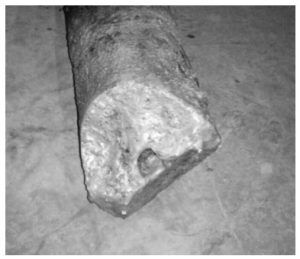
Statistical classification of stopper rod accidents suggests that the main factors affecting stopper rod breakage and stopper rod head detachment are thermal shock, strength, and stopper rod design and installation issues.
Thermal shock problem
An analysis of the stopper rod’s body and head material design, as well as its manufacturing process, indicates that the currently used stopper rod material meets the process requirements. The steel plant primarily uses carbon structural steel, high-carbon steel, and some medium-carbon alloy steel, which have minimal erosion on the stopper rod. The stopper rod does not have a slag line, and the erosion of the stopper rod head is not severe. After 15 hours of normal steel pouring, the flow control at the stopper rod head is good, and the erosion is uniform. The material design is generally reasonable. However, the fracture surface of the broken stopper rod head is 50-60 mm, with a clean break. The primary issue to address is the stopper rod manufacturing process, which requires adjustments and improvements. The uneven composition of the raw materials used in manufacturing the stopper rod, leading to stress, is the direct cause of the stopper rod fracture.
The baking process of the tundish was monitored on-site, revealing a problem with low baking efficiency. The tundish baking used converter gas with a calorific value of approximately 1300 × 4.1868 kJ/m³, lasting 3 hours. During baking, the stopper rod was open, the baking temperature was 1000 °C, and the tundish was not sealed, resulting in significant flame overflow. Poor stopper rod baking leads to uneven thermal stress in the stopper rod refractory material, thus causing microcracks. Since the stopper rod operates in an extreme environment during casting, even small defects are magnified.
Strength issue
The problem of stopper rod fracture at the slag line typically occurs 1-2 heats after the tap changer is replaced during steel casting, after bonding recovery, and during the tundish quick change process. Analysis suggests that the stopper rod develops cracks and eventually fractures when it is closed during the steel casting process due to lateral and longitudinal forces.
Analysis of the strength of the stopper rod body revealed that its strength is low in the hot state, making it prone to breakage under the influence of molten steel or stress. Therefore, the strength of the stopper rod body needs to be strengthened.
Design and installation of stopper rod
The installation of the stopper rod on site was monitored and analyzed as follows: ① There are problems with the stopper rod design. When the stopper rod is open during steel pouring, it protrudes 200 mm above the tundish cover. According to the normal design, a protrusion of 50 mm above the tundish cover is sufficient. The stopper rod is too long, and in an emergency, it will be subjected to enormous external forces when closed, making it prone to breakage, especially at the slag line where the stopper rod diameter changes, making this area even weaker. ② There are problems with the stopper rod installation. The main issue is that the stopper rod is installed offline. The tundish loading process may cause shaking damage. The stopper rod installation requires a “bite,” and the presence of this “bite” causes lateral forces when the stopper rod is closed, leading to cracks in the stopper rod head or weaker parts. Furthermore, during the steel pouring process, the operator switched the mode from automatic to manual and then forcefully pressed the brake to close the stopper rod, further exacerbating the damage.
Improvement measures
Improvement of stopper rod breakage problem
In response to the above problems, we consider improving the stopper rods currently in use. The specific solutions are as follows: (1) Under the premise of meeting production requirements, we will make minor adjustments to the material to appropriately improve the thermal shock performance of the stopper rods and strengthen the neck strength of the stopper rods. The adjustment idea is to introduce SiC micro powder into the feed of the stopper rods in the tundish production, focusing on the head of the stopper rod and the slag line position, and to design a composite structure for the stopper rods to improve the comprehensive mechanical properties of the stopper rods and reduce the coefficient of linear expansion. When 5% SiC micro powder is added, the room temperature and high temperature flexural strength of the magnesium carbon rod head material are 8.2 MPa and 9.4 MPa, respectively, and the average coefficient of linear expansion is 7.1×10-/℃. No obvious cracks were observed after 3 thermal shock cycles at 1100 ℃. (2) Adjustment of the length of the stopper rod. The stopper rods currently in use are too long, reaching 1750 mm, which increases the difficulty of the stopper rod manufacturing and will also amplify the lateral force generated by the flow of molten steel during use, causing the rod body to break after being stressed. Based on the site conditions, the length of the stopper rods will be adjusted to 1650 mm. (3) Optimize the stopper head by changing the shape of the stopper head from spherical to conical to improve the flow control accuracy of the stopper. At the same time, change the size of the stopper head from 60 mm to 45 mm.
Improved plug installation method
Currently, the stopper rods are installed in the repair area, and vibrations during the transport of intermediate packages can adversely affect them. The existing stopper rod installation process should be improved by changing from offline installation to online installation before the intermediate package is baked, reducing the impact of intermediate package transportation. Additionally, before debugging the stopper rods, check the opening and closing beam for deformation and observe whether the stopper rods are straight. During installation and debugging, eliminate any “biting” and ensure strict alignment to prevent the stopper rods from breaking due to lateral forces during flow control.
Optimization of the baking process for stopper rods
To address thermal shock issues, the stopper rod baking procedure was optimized. When closing the tundish offline, the rim should be sealed tightly, and strict sealing is required before baking to improve the baking effect. The stopper rod should be closed when the tundish begins baking; it should be opened after half an hour of baking to facilitate the baking of the stopper rod and the water inlet. The tundish baking procedure was revised to specify a reasonable baking time. Prolonged baking shortens the tundish’s lifespan and may even render it unusable. The furnace must not be shut off during baking; otherwise, the tundish will be disposed of as unusable. The gas valve opening must be strictly controlled according to the tundish baking curve to ensure the temperature rises to above 1000℃ during the 1-2 hour baking period.
Improve the operation of stopper rods during the initial casting and steel pouring processes.
Instead of the existing practice of “checking the stopper” during the intermediate bread baking process, the practice will be changed to stopping baking before pouring and checking the stopper. If there is a small deviation in the stopper, it will be fine-tuned to reduce the negative impact caused by stopping baking and making forceful adjustments to the stopper during the baking process.
During the processes of changing the sprue nozzle, restoring bonding, and quick replacement of the tundish, the mode is first switched from “automatic” to “manual”. The operator holds the stopper rod handle, and the stopper rod closes by its own weight. Then the operator presses the handle to close the stopper rod and proceeds with the subsequent operations.
Implementation process and results
The above measures will be implemented in two steps: First, improve the tundish baking process, strengthen the tundish sealing, and improve the stopper baking effect, while improving the stopper installation and operation; second, optimize the stopper, with the manufacturer designing improved stopper drawings, manufacturing molds and stoppers, and conducting on-site testing when conditions permit.
The improved stopper rod was tested on-site. The process of baking, pouring and casting of the stopper rod was tracked. The stopper rod was required to be lifted out each time the machine was stopped. The steel grades cast included Q235, Q345, 45# and 50#. The condition of the stopper rod head was observed. The flow control was good and the stopper rod head was uniform.
The implementation of the above measures has achieved certain results. The number of continuous casting machine shutdown accidents caused by stopper rod breakage has gradually decreased. In 2022, the steel plant experienced only 2 stopper rod breakage accidents, a decrease of 10 compared to 2021, and the use of stopper rods has become more stable.
in conclusion
By controlling the trace additives added during the production of stopper rods and optimizing the rod shape, the thermal stability and flow control accuracy of the stopper rods can be improved, which is beneficial for stabilizing the liquid level in the crystallizer, reducing the number of stopper rod opening and closing cycles, and improving the performance of the stopper rods.
Through improvements and optimizations in on-site stopper installation, baking, and use, the breakage problems caused by thermal shock and mechanical damage to the stoppers have been reduced, making the use of tundish stoppers more stable.More information,please visit
Henan Yangyu Refractories Co.,Ltd