

-
Why Birth Certificate Attestation Is Required in UAE
Introduction
The UAE has become one of the world’s leading destinations for expatriates, investors, professionals, and international families. Millions of residents relocate to Dubai and other Emirates every year for employment, business opportunities, education, and long term residency.
As part of UAE immigration and legal compliance procedures, official foreign documents often require attestation before they can be accepted by government authorities. One of the most important documents frequently requiring legalization is the birth certificate.
Birth certificate attestation Dubai is an essential legal process used to verify the authenticity of a birth certificate issued outside the UAE. The attestation process confirms that the document is genuine and officially recognized for legal use within the UAE.
Birth certificates are commonly required for:
-
Child visa applications
-
Family sponsorship
-
School admissions
-
Emirates ID processing
-
Immigration procedures
-
Passport applications
-
Legal guardianship matters
Without proper attestation, UAE authorities may reject foreign issued birth certificates during official processes.
Understanding birth certificate attestation in UAE requirements is important for expatriate families, investors, entrepreneurs, and residents planning immigration or family related procedures in Dubai.
In this comprehensive guide, you will learn why birth certificate attestation is required in UAE, where it is used, the attestation process, required documents, estimated costs, common challenges, and how Takween Advisory can help simplify document legalization procedures.
What Is Birth Certificate Attestation?
Birth certificate attestation is the official verification and legalization process confirming that a birth certificate is authentic and legally valid for use in another country.
The process typically involves approvals from:
-
Notary authorities
-
Government departments
-
Foreign affairs ministries
-
UAE embassy or consulate
-
UAE Ministry of Foreign Affairs
The attestation process ensures the document is legally recognized by UAE authorities.
Why Birth Certificate Attestation Is Required in UAE
Immigration and Residency Applications
Birth certificates are commonly required during:
-
Child visa applications
-
Family sponsorship procedures
-
Residency visa processing
UAE immigration authorities generally require attested documents to verify family relationships legally.
School and Educational Admissions
Educational institutions in UAE may request attested birth certificates for:
-
Student admissions
-
Age verification
-
Academic registration procedures
Emirates ID and Government Services
Government agencies may require attested birth certificates when processing:
-
Emirates ID applications
-
Family registration procedures
-
Official government records
Legal Verification of Identity and Parentage
Attestation confirms the legitimacy of personal information such as:
-
Child’s identity
-
Date of birth
-
Parent names
-
Nationality details
International Legal Recognition
Attestation helps foreign issued documents gain legal recognition within UAE jurisdiction.
Situations Where Birth Certificate Attestation Is Commonly Needed
Child Visa Sponsorship
Families applying for child residency visas usually require attested birth certificates.
Family Residency Applications
Birth certificates help establish family relationships during immigration procedures.
School Enrollments
Many schools request legalized birth certificates during student registration.
Passport and Consular Procedures
Embassies and consulates may require attested birth certificates for international documentation.
Legal Guardianship Matters
Attested birth certificates may support legal guardianship or custody related procedures.
Birth Certificate Attestation Process in UAE
Step 1: Obtain Original Birth Certificate
Applicants must secure the original or certified birth certificate from the issuing country.
Step 2: Notarization Where Required
Some countries require notarization before further legalization procedures.
Step 3: Government Authentication
Relevant government authorities verify the document authenticity.
Step 4: UAE Embassy or Consulate Attestation
The UAE embassy or consulate in the issuing country may authenticate the document.
Step 5: UAE Ministry of Foreign Affairs Attestation
Once the document arrives in UAE, final legalization may be completed through UAE authorities.
Documents Required for Birth Certificate Attestation Dubai
Requirements may vary depending on country of origin and intended use.
However, common requirements may include:
-
Original birth certificate
-
Passport copies
-
Visa or Emirates ID copies
-
Application forms
-
Supporting immigration documents
-
Legal translation where applicable
Additional documents may be requested depending on the case.
Importance of Legal Translation
If the birth certificate is not issued in Arabic or English, legal translation may be required.
Certified translation helps authorities review and process documents accurately.
Birth Certificate Attestation Online Services
Many service providers now offer birth certificate attestation online assistance to simplify document processing.
Online support may help with:
-
Application tracking
-
Document collection coordination
-
Status updates
-
Courier arrangements
-
Consultation support
Digital services help reduce delays and improve convenience for applicants.
Common Challenges in Birth Certificate Attestation
Incomplete Documentation
Missing documents may delay processing or cause rejection.
Incorrect Translation
Improper legal translation can create legal complications.
Damaged or Unclear Certificates
Poor quality documents may not be accepted by authorities.
Country Specific Procedures
Attestation rules vary depending on the issuing country.
Delayed Embassy Processing
Embassy approvals sometimes require additional processing time.
Importance of Professional Attestation Support
Professional document consultants can help applicants:
-
Understand country specific procedures
-
Organize documentation properly
-
Coordinate embassy legalization
-
Avoid application errors
-
Manage timelines efficiently
This can reduce delays and improve overall processing accuracy.
Estimated Costs for Birth Certificate Attestation in UAE
The cost of birth certificate attestation Dubai may vary depending on several factors such as:
-
Country of origin
-
Embassy legalization requirements
-
Translation requirements
-
Courier and document handling services
-
Urgent processing requests
-
Government authentication procedures
-
Administrative support requirements
Estimated costs may include:
-
Notarization charges
-
Embassy attestation fees
-
Ministry authentication fees
-
Legal translation expenses
-
Courier and logistics charges
-
Administrative and consultancy fees
Applicants should understand that government regulations, embassy procedures, legalization requirements, and official fees may change over time without prior notice.
Professional consultancy fees, third party service charges, and administrative costs may vary depending on the service provider and processing complexity.
Consulting experienced professionals can help applicants receive updated guidance and customized attestation solutions.
Real Life Example of Birth Certificate Attestation
A family relocating to Dubai needed attested birth certificates for their children’s residency visas and school admissions.
The family completed the following process:
Step 1: Obtained original birth certificates from home country
Step 2: Completed notarization and government authentication
Step 3: Received UAE embassy legalization
Step 4: Completed UAE Ministry attestation procedures
Step 5: Submitted attested documents for residency processing
As a result, the family successfully completed child visa approvals and school enrollment procedures in Dubai.
Pros and Cons of Birth Certificate Attestation
Pros
-
Legal recognition of foreign documents
-
Required for immigration and residency procedures
-
Supports school admissions
-
Simplifies family sponsorship applications
-
Improves compliance with UAE regulations
-
Enables access to official government services
Cons
-
Multi step legalization process
-
Country specific requirements
-
Translation obligations
-
Embassy processing delays
-
Administrative costs and documentation complexity
How Takween Advisory Can Help
Takween Advisory provides professional support for families, investors, professionals, and expatriates seeking birth certificate attestation Dubai services and UAE document legalization assistance.
Their services may include:
-
Birth certificate attestation support
-
UAE embassy legalization coordination
-
Ministry attestation guidance
-
Legal translation assistance
-
Immigration documentation support
-
Child visa consultation
-
Family residency advisory
-
Corporate and personal document attestation
-
Administrative coordination services
Takween Advisory helps clients simplify UAE document legalization procedures while ensuring compliance with immigration and regulatory requirements.
Their experienced team supports expatriates, entrepreneurs, investors, professionals, and families across Dubai and the UAE with transparent and customized attestation solutions.
Frequently Asked Questions
Why is birth certificate attestation required in UAE?
Attestation verifies document authenticity for legal use during immigration, residency, education, and government procedures.
Is birth certificate attestation mandatory for child visas?
In most cases, attested birth certificates are required for child visa and family sponsorship applications.
Can birth certificate attestation be completed online?
Many providers offer birth certificate attestation online support services for document coordination and processing assistance.
Does every foreign birth certificate require attestation?
Requirements may vary depending on immigration procedures and authority regulations.
Is legal translation required for birth certificates?
Legal translation may be necessary if the document is not in Arabic or English.
How long does attestation processing take?
Processing timelines vary depending on the issuing country, embassy procedures, and document requirements.
Why should applicants use professional attestation consultants?
Professional consultants help simplify documentation, embassy coordination, legal translation, and compliance management.
Conclusion
Understanding birth certificate attestation Dubai requirements is essential for expatriate families, investors, entrepreneurs, and professionals planning immigration, residency, education, or legal procedures in the UAE. Attestation ensures foreign issued birth certificates are legally recognized by UAE authorities and accepted during official processes.
From child visa applications and school admissions to family sponsorship and government services, attested birth certificates play a critical role in maintaining compliance with UAE regulations. Proper legalization, accurate translation, and organized documentation can significantly reduce delays and avoid administrative complications.
As UAE immigration and documentation procedures continue evolving, applicants should remain informed and seek professional assistance where necessary. Takween Advisory can help individuals and families navigate birth certificate attestation in UAE requirements with expert guidance, customized support solutions, and professional document legalization services tailored to Dubai’s regulatory environment.
Thank you for reading this blog and exploring birth certificate attestation Dubai. Birth certificate attestation in Dubai is an important legal process required to verify the authenticity of a birth certificate for official use in the UAE. This procedure is commonly needed for family visa applications, child sponsorship, school admissions, immigration processes, residency applications, and various government-related requirements. The attestation process typically involves verification by the relevant authorities in the country where the certificate was issued, followed by authentication from the appropriate foreign affairs authorities and UAE authorities where applicable. Proper attestation confirms that the document is genuine and legally recognized for use within the UAE. Accurate documentation and compliance with attestation requirements are essential to avoid delays or rejection during visa or legal procedures. Professional attestation services can help streamline the process by ensuring that all documentation is prepared and submitted correctly. With proper guidance and timely processing, birth certificate attestation in Dubai can be completed efficiently, allowing individuals and families to use their documents for official and legal purposes throughout the UAE.
-
-
Difference Between Fit Out and Renovation UAE
Introduction
Dubai’s real estate and construction sector is one of the most dynamic in the world, driven by continuous development in commercial towers, residential communities, retail spaces, and hospitality projects. As businesses expand and property owners upgrade their spaces, two commonly used terms often create confusion: fit out and renovation.
While both involve improving or modifying a space, they differ significantly in scope, purpose, execution, and regulatory requirements. Understanding these differences is essential for property owners, tenants, investors, and businesses planning interior works in the UAE.
The demand for fit out renovation Dubai services has increased due to rapid business expansion, new office setups, retail branding requirements, and lifestyle upgrades in residential properties. However, choosing the right approach depends on whether the project involves finishing a new space or upgrading an existing one.
In this detailed guide, you will learn the difference between fit out and renovation, their processes, types, cost factors, approvals, benefits, and how Takween Advisory can help with professional space development solutions.
What Is Fit Out in UAE?
Fit out refers to the process of making an interior space ready for occupation after the structural construction is completed.
It typically involves transforming a bare shell into a fully functional space.
Types of Fit Out Work
Shell and Core Fit Out
This includes:
-
Flooring installation
-
Ceiling systems
-
Electrical wiring
-
HVAC systems
-
Partitioning
-
Lighting setup
Category A Fit Out
Basic interior completion including:
-
Raised flooring
-
Suspended ceilings
-
Basic lighting
-
Mechanical systems
Category B Fit Out
Custom interior design based on business or residential needs:
-
Furniture installation
-
Branding elements
-
Interior design finishes
-
Workstations and layouts
Fit out projects are common in offices, retail stores, restaurants, and commercial buildings.
What Is Renovation in UAE?
Renovation refers to improving, upgrading, or restoring an existing space.
It focuses on modifying or enhancing already built interiors or structures.
Types of Renovation Work
Residential Renovation
-
Kitchen upgrades
-
Bathroom remodeling
-
Flooring replacement
-
Wall redesign
-
Lighting improvement
Commercial Renovation
-
Office redesign
-
Retail space upgrade
-
Layout restructuring
-
Branding refresh
-
Infrastructure improvement
Renovation aims to modernize or repair an existing space rather than starting from a bare shell.
Key Difference Between Fit Out and Renovation
Purpose of Work
-
Fit out renovation Dubai focuses on preparing a new or empty space for use
-
Renovation focuses on improving or upgrading an existing space
Starting Condition
-
Fit out starts from a shell or unfinished interior
-
Renovation starts from a completed and occupied space
Scope of Work
-
Fit out includes complete interior development
-
Renovation includes partial or full upgrades
Design Approach
-
Fit out allows full customization from scratch
-
Renovation works within existing structural limitations
Level of Construction
-
Fit out involves extensive construction and installation
-
Renovation involves modification and refurbishment
Fit Out Renovation Process in Dubai
Step 1: Site Assessment
Evaluate space condition, structure, and requirements.
Step 2: Design Planning
Develop layout, interior design, and functionality plan.
Step 3: Authority Approvals
Obtain approvals from relevant Dubai authorities if required.
Step 4: Material Selection
Choose materials, finishes, and interior elements.
Step 5: Execution and Construction
Carry out installation, wiring, and structural modifications.
Step 6: Final Inspection and Handover
Ensure compliance and complete project delivery.
When Do You Need Fit Out Services?
Fit out is required when:
-
Moving into a new office space
-
Opening a retail store
-
Launching a restaurant
-
Leasing commercial property in shell condition
-
Setting up a new business space
When Do You Need Renovation Services?
Renovation is required when:
-
Upgrading old interiors
-
Rebranding business spaces
-
Improving residential property value
-
Fixing damaged interiors
-
Enhancing functionality of existing spaces
Cost Factors for Fit Out and Renovation in UAE
The cost of fit out renovation in Dubai depends on several factors such as:
-
Size of the property
-
Type of project (commercial or residential)
-
Quality of materials used
-
Design complexity
-
Labor requirements
-
Authority approvals
-
Electrical and mechanical works
-
Custom furniture and finishes
Estimated costs may include:
-
Design and consultancy fees
-
Construction and labor charges
-
Material procurement costs
-
MEP works (mechanical, electrical, plumbing)
-
Interior furnishing costs
-
Approval and permit fees
-
Project management services
Costs vary significantly based on project scope and customization requirements.
It is important to note that government regulations, material pricing, and contractor charges may change over time without prior notice.
Consultancy fees, contractor charges, and third party service costs may vary depending on service provider and project complexity.
Importance of Approvals in Dubai Fit Out Projects
Certain fit out renovation in UAE projects require approvals from authorities depending on:
-
Building type
-
Location
-
Project scope
-
Structural changes
-
Safety regulations
Approvals ensure:
-
Compliance with safety standards
-
Legal construction practices
-
Structural integrity
-
Fire safety compliance
Common Challenges in Fit Out and Renovation Projects
Poor Planning
Lack of proper design planning may lead to delays.
Budget Overruns
Unexpected costs may increase total project expenses.
Approval Delays
Authority approvals may take time depending on project type.
Contractor Selection Issues
Poor contractor selection can affect quality and timelines.
Design Misalignment
Mismatch between design expectations and execution.
Benefits of Professional Fit Out and Renovation Services
Improved Space Efficiency
Better layout and functionality optimization.
Enhanced Aesthetics
Modern and visually appealing interiors.
Increased Property Value
Well designed spaces increase market value.
Brand Identity Enhancement
Commercial spaces reflect strong branding.
Long Term Durability
High quality materials ensure long lasting performance.
Real Life Example of Fit Out Renovation Project
A Dubai based company leasing a commercial office space required a complete interior setup.
Step 1: Conducted space assessment
Step 2: Designed customized office layout
Step 3: Obtained necessary approvals
Step 4: Completed full fit out execution
Step 5: Installed workstations and branding elements
As a result, the company successfully launched a fully functional office space aligned with brand identity and operational needs.
Pros and Cons of Fit Out and Renovation
Pros
-
Customized interior solutions
-
Improved space utilization
-
Enhanced property value
-
Better functionality and aesthetics
-
Compliance with UAE standards
Cons
-
High initial investment
-
Time consuming process
-
Approval requirements
-
Design and execution complexity
-
Potential project delays
How Takween Advisory Can Help
Takween Advisory provides professional support for businesses and property owners seeking fit out renovation Dubai and UAE interior development solutions.
Their services may include:
-
Fit out project consultation
-
Renovation planning and advisory
-
Design coordination support
-
Authority approval assistance
-
Project management guidance
-
Commercial interior setup support
-
Residential renovation advisory
-
Compliance and documentation assistance
-
Cost planning and budgeting support
Takween Advisory helps clients transform spaces efficiently while ensuring compliance with UAE construction and interior regulations.
Their experienced team supports startups, businesses, investors, and property owners across Dubai and the UAE with customized and professional fit out and renovation advisory services.
Frequently Asked Questions
What is the difference between fit out and renovation?
Fit out involves completing a new space, while renovation involves upgrading an existing one.
Which is more expensive, fit out or renovation?
Costs depend on scope, but full fit out projects are often more extensive.
Do fit out projects require approval in Dubai?
Yes, many commercial fit out projects require authority approvals.
Can residential properties be renovated in UAE?
Yes, residential renovation is common for kitchens, bathrooms, and interiors.
What industries use fit out services most?
Offices, retail, hospitality, and restaurants commonly use fit out services.
How long does a fit out project take?
Timelines vary based on size, design, and approval requirements.
Why hire professional consultants for fit out projects?
Consultants help with design, approvals, budgeting, and project execution.
Conclusion
Understanding the difference between fit out renovation Dubai and renovation services in UAE is essential for property owners, tenants, and businesses planning interior development projects. While fit out focuses on creating fully functional spaces from scratch, renovation focuses on upgrading and improving existing interiors.
Both processes play a key role in shaping modern commercial and residential environments across Dubai’s fast growing real estate sector. Proper planning, compliance with regulations, and professional execution are critical for successful project delivery.
As Dubai continues to expand its infrastructure and business ecosystem, demand for fit out renovation in UAE services is expected to grow significantly. Takween Advisory can help clients navigate fit out renovation in Dubai requirements with expert guidance, project advisory support, and customized solutions tailored to UAE construction and interior development needs.
Thank you for reading this blog. If you are searching for fit out renovation Dubai, it is important to understand that professional fit-out and renovation services play a crucial role in transforming residential, commercial, retail, and office spaces into functional and visually appealing environments. Fit out renovation in Dubai typically includes interior design, space planning, civil works, partitioning, flooring, ceiling installation, painting, lighting, MEP (mechanical, electrical, and plumbing) works, furniture installation, and final finishing. These services help businesses create productive workspaces, enhance customer experiences, and improve the overall value and functionality of a property. Depending on the scope of the project, approvals from relevant authorities may be required to ensure compliance with local building and safety regulations. Proper project planning, budgeting, and execution are essential for achieving high-quality results within the desired timeframe. With professional expertise and project management support, fit-out renovation projects in Dubai can be completed efficiently, delivering modern, practical, and attractive spaces that meet both business and lifestyle needs.
-
-
Who Can Sponsor a Child Visa in UAE
Introduction
The UAE is home to millions of expatriates who live and work in Dubai and across the Emirates with their families. As Dubai continues attracting professionals, entrepreneurs, investors, and skilled workers from around the world, family residency solutions have become an important part of the UAE immigration system.
One of the most common immigration requirements for expatriate families is obtaining a child visa. Parents residing legally in the UAE often wish to sponsor their children so they can live, study, and access healthcare services in the country.
A child visa Dubai allows eligible children to legally reside in the UAE under the sponsorship of a parent or legal guardian. However, sponsorship eligibility depends on several immigration rules, residency conditions, income requirements, and supporting documentation.
Understanding child visa in UAE regulations is essential for families planning long term residency in Dubai. Proper preparation and compliance can help avoid delays, application rejection, or immigration complications.
In this comprehensive guide, you will learn who can sponsor a child visa in UAE, eligibility requirements, application procedures, required documents, estimated costs, common challenges, and how Takween Advisory can help families manage the process smoothly.
What Is a Child Visa in UAE?
A child visa is a UAE residency visa issued to dependent children under the sponsorship of eligible parents or guardians residing legally in the UAE.
The visa generally allows children to:
-
Reside legally in the UAE
-
Access education services
-
Obtain healthcare coverage
-
Travel in and out of the UAE
-
Maintain legal residency status with family members
Child residency visas are commonly linked to:
-
Employment visas
-
Investor visas
-
Business owner visas
-
Professional residency permits
-
Family sponsorship visas
The visa validity period depends on the sponsor’s residency status and immigration approvals.
Who Can Sponsor a Child Visa in UAE?
Father as Sponsor
In most cases, the father is the primary sponsor for child visas in UAE.
Eligible fathers may sponsor children if they:
-
Hold valid UAE residency
-
Meet minimum salary or financial requirements
-
Maintain approved accommodation
-
Provide supporting documentation
The father’s visa category may include:
-
Employment visa
-
Investor visa
-
Partner visa
-
Business owner visa
-
Professional residency visa
Mother as Sponsor
In certain cases, mothers may sponsor children in the UAE.
This may apply when:
-
The father is not residing in UAE
-
The mother holds a valid residency visa
-
Immigration conditions are satisfied
-
Required income criteria are met
Approval conditions may vary depending on immigration regulations and specific circumstances.
Investor and Business Owner Sponsors
Entrepreneurs and investors holding valid investor visas may sponsor dependent children if immigration eligibility conditions are fulfilled.
This is common among:
-
Business owners
-
Company shareholders
-
Free zone investors
-
Startup founders
Legal Guardians
In limited situations, legal guardians may sponsor children subject to immigration approvals and supporting legal documentation.
Eligibility Requirements for Child Visa Dubai
Eligibility requirements may vary depending on immigration category and family circumstances.
However, common requirements may include:
-
Valid UAE residency visa for sponsor
-
Minimum income eligibility
-
Valid passport for child
-
Birth certificate
-
Emirates ID of sponsor
-
Proof of accommodation
-
Medical insurance where applicable
-
Attested legal documents
Authorities may request additional documents depending on the case.
Age Requirements for Child Visa in UAE
Child visa eligibility may depend on the child’s age and educational status.
General immigration rules may apply differently for:
-
Male children
-
Female children
-
Students
-
Children with special circumstances
Parents should review updated immigration regulations before applying.
Child Visa Application Process in Dubai
Step 1: Verify Sponsorship Eligibility
The sponsor must confirm eligibility based on residency status and immigration rules.
Step 2: Prepare Required Documents
Documents may include:
-
Child passport copy
-
Passport sized photographs
-
Sponsor passport and visa copy
-
Emirates ID
-
Birth certificate
-
Tenancy contract
-
Salary certificate where applicable
Step 3: Submit Entry Permit Application
Applications may be submitted through approved immigration channels or authorized service centers.
Step 4: Complete Medical Insurance and Biometrics
Depending on age and visa category, additional procedures may apply.
Step 5: Visa Stamping and Residency Approval
Once approved, the child residency visa is issued and linked to the sponsor’s residency file.
Important Documents Required for Dubai Child Visa
Birth Certificate
Birth certificates generally require attestation and legal translation where applicable.
Passport Validity
Children must hold valid passports meeting immigration validity requirements.
Sponsor Residency Documents
Sponsors must provide valid UAE residency proof.
Proof of Accommodation
Families may need to provide tenancy contracts or accommodation proof.
Salary or Financial Proof
Sponsors may need to demonstrate financial capability.
Benefits of Child Visa in UAE
Family Stability
Child visas allow families to live together legally within the UAE.
Access to Education
Children with valid residency visas can enroll in schools and educational institutions.
Healthcare Access
Residents may access healthcare services and insurance facilities.
Long Term Residency Planning
Families can establish long term stability in Dubai through legal residency structures.
Easier International Travel
Residency status simplifies travel procedures for dependent children.
Child Visa Online Services in UAE
Many immigration related services are now available digitally.
Families may complete various procedures through child visa online systems, including:
-
Application submissions
-
Status tracking
-
Document uploads
-
Renewal procedures
-
Immigration updates
Online systems help simplify visa management and reduce processing delays.
Common Challenges in Child Visa Applications
Documentation Errors
Incorrect or incomplete paperwork may delay approvals.
Birth Certificate Attestation Issues
Foreign documents often require proper attestation before acceptance.
Salary Requirement Confusion
Sponsors sometimes misunderstand financial eligibility conditions.
Expired Residency Documents
Expired sponsor visas may affect child visa approvals.
Delayed Renewals
Late renewals can create residency complications and penalties.
Estimated Costs for Child Visa Dubai UAE
The cost of obtaining a child visa Dubai UAE depends on several factors such as:
-
Sponsor visa category
-
Immigration approvals
-
Number of dependent children
-
Medical insurance requirements
-
Document attestation
-
Visa duration
-
Government service charges
-
Administrative processing requirements
Estimated costs may include:
-
Entry permit fees
-
Residency visa processing charges
-
Emirates ID fees
-
Medical insurance expenses
-
Document attestation costs
-
Translation services
-
Administrative and consultancy charges
Families should note that immigration regulations, government fees, and residency policies may change over time without prior notice.
Professional consultancy charges, third party service costs, and administrative fees may vary depending on service providers and specific case requirements.
Consulting experienced professionals can help families receive updated guidance and customized visa support solutions.
Real Life Example of Child Visa Sponsorship
A Dubai based entrepreneur holding an investor visa planned to sponsor residency visas for two children relocating from overseas.
The family completed the following process:
Step 1: Verified sponsorship eligibility
Step 2: Prepared attested birth certificates
Step 3: Submitted child visa applications
Step 4: Completed insurance and immigration procedures
Step 5: Received child residency approvals
As a result, the family successfully relocated and established long term residency in Dubai.
Pros and Cons of UAE Child Visa Sponsorship
Pros
-
Legal residency for children
-
Access to education and healthcare
-
Family stability
-
Simplified travel procedures
-
Long term residency opportunities
-
Access to UAE lifestyle benefits
Cons
-
Documentation requirements
-
Immigration processing timelines
-
Renewal obligations
-
Government policy updates
-
Compliance and sponsorship conditions
How Takween Advisory Can Help
Takween Advisory provides professional immigration and residency support for families seeking child visa Dubai solutions and UAE family sponsorship services.
Their services may include:
-
Child visa application support
-
Family visa processing
-
Immigration documentation assistance
-
Residency renewal guidance
-
Investor and employment visa consultation
-
Emirates ID support
-
Document attestation coordination
-
Business owner residency solutions
-
Corporate and immigration advisory services
Takween Advisory helps families simplify UAE immigration procedures while ensuring compliance with residency regulations and documentation requirements.
Their experienced team supports professionals, entrepreneurs, investors, and expatriate families across Dubai and the UAE with customized and transparent visa support solutions.
Frequently Asked Questions
Who can sponsor a child visa in UAE?
Eligible parents with valid UAE residency visas may sponsor dependent children subject to immigration requirements.
Can mothers sponsor child visas in UAE?
Yes. In certain situations, mothers may sponsor children depending on residency status and immigration approvals.
What documents are required for a child visa Dubai?
Common documents include passports, birth certificates, sponsor residency documents, photographs, and accommodation proof.
Can investor visa holders sponsor children?
Yes. Eligible investor visa holders may sponsor dependent children subject to UAE immigration regulations.
Is medical insurance required for child visas?
Medical insurance requirements may apply depending on visa category and emirate regulations.
Can applications be completed through child visa online systems?
Yes. Many immigration services and visa procedures are available through digital platforms and approved service channels.
What happens if a child visa expires?
Expired visas may result in penalties, legal complications, or residency issues if not renewed on time.
Conclusion
Understanding child visa Dubai requirements is essential for expatriate families, investors, professionals, and entrepreneurs planning long term residency in the UAE. A child visa allows dependent children to legally reside in Dubai while accessing education, healthcare, and family support within one of the world’s most dynamic international communities.
From sponsorship eligibility and documentation preparation to residency approvals and renewal management, families must carefully follow UAE immigration procedures to ensure smooth processing and compliance. Proper planning and accurate documentation can significantly reduce delays and avoid unnecessary complications.
As UAE immigration regulations continue evolving, families should stay informed and seek professional assistance when necessary. Takween Advisory can help families navigate child visa in UAE requirements with expert guidance, personalized immigration support, and professional residency solutions tailored to Dubai’s evolving immigration environment.
Thank you for reading this blog. If you are searching for child visa online, it is important to understand that a child visa in the UAE allows residents to sponsor their children so they can legally live, study, and access essential services in Dubai and across the United Arab Emirates. The child visa online application process typically involves submitting an application through official UAE immigration portals or approved service channels along with required documents such as passport copies, birth certificate, sponsor’s residency visa, Emirates ID, photographs, and proof of income or accommodation. Depending on the case, additional steps such as medical insurance, Emirates ID registration, and visa stamping may also be required after approval. A child visa provides important benefits including legal residency, access to education, healthcare, and the ability for families to live together in the UAE. Proper documentation and compliance with UAE immigration regulations are essential to ensure smooth processing and avoid delays. With accurate preparation and guidance, the online application process can be completed efficiently.
-
-
Dubai Company Formation Complete Guide for Entrepreneurs
Why Entrepreneurs Around the World Are Choosing Dubai for Business Formation
Dubai has quietly become one of the most competitive business destinations on Earth. Entrepreneurs from over 200 nationalities call this emirate home, and foreign nationals make up more than 80 percent of its population. That number alone speaks volumes about the kind of open, opportunity-rich environment Dubai has built for business owners.
Whether you are launching a tech startup, setting up a trading company, or expanding an established international brand into the Middle East, Dubai company formation is a path worth taking seriously. The city sits at the crossroads of Asia, Europe, and Africa, offering unparalleled access to global markets. Its infrastructure, regulatory environment, and lifestyle quality consistently rank it among the world’s top business hubs.
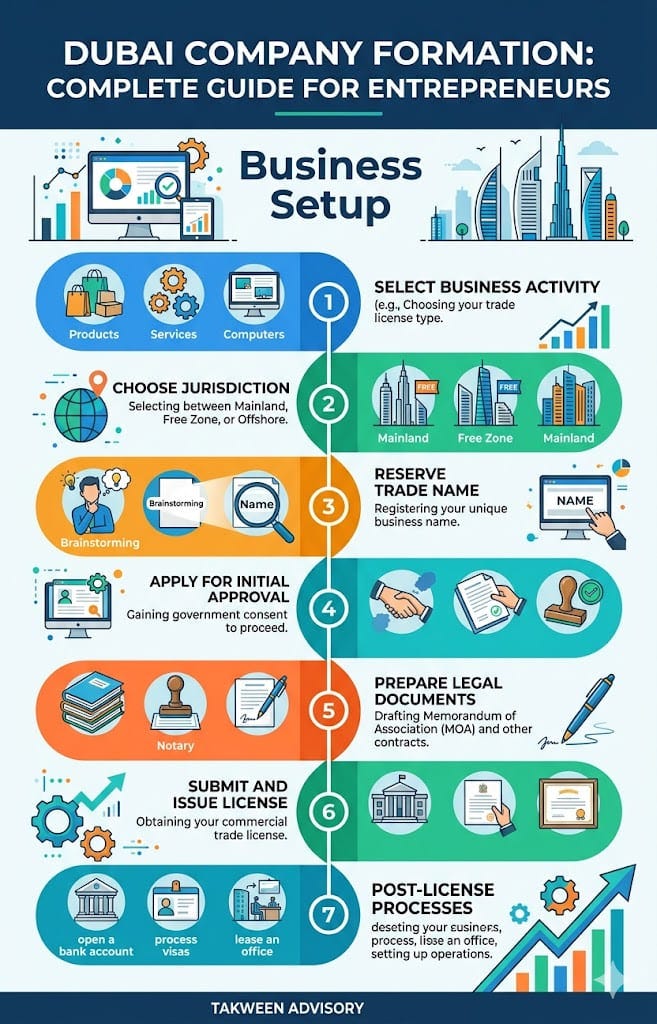
This guide covers everything you need to know about business setup in Dubai, including the types of business structures available, where to locate your company, what licenses you need, what documents to prepare, and what the tax landscape looks like heading into 2025.
Understanding the Legal Framework for Business Formation in Dubai
Before you take your first step, it helps to understand the rules of the game. Business formation in Dubai is governed primarily by the Federal Decree Law №32 of 2021 on Commercial Companies. This landmark legislation updated the previous regulatory framework and opened the door for 100 percent foreign ownership across most business sectors, ending a requirement that had long required foreign entrepreneurs to take on a local Emirati partner holding at least 51 percent of the company.
On the mainland, companies are regulated by the UAE Department of Economic Development (DED). In free zones, each authority operates under its own independent set of rules. Offshore arrangements follow a separate regulatory track altogether. Understanding which jurisdiction governs your planned activity is the first step in any Dubai company registration process.
The Three Business Jurisdictions in Dubai

One of the most important early decisions in any Dubai company setup is choosing between three distinct jurisdictions. Each comes with its own advantages, restrictions, and ideal use cases.
Mainland Company Formation
A mainland company in Dubai allows you to operate freely across the UAE and internationally without restriction. You can trade directly with local consumers and government entities, take on contracts anywhere in the country, and set up offices wherever you choose. The Department of Economic Development (DED) governs mainland businesses and issues trade licenses across commercial, industrial, professional, and other categories.
Under current regulations, foreign investors can own 100 percent of many types of mainland businesses. However, certain sensitive sectors, such as oil and gas, utilities, and some forms of retail trade, may still require local partnership arrangements. For most business activities, full foreign ownership is now permitted.
Mainland companies must maintain a physical office, and tenancy contracts must be registered through the Dubai Land Department’s Ejari portal.
Free Zone Company Formation
Dubai hosts over 30 specialized free zones, each tailored to a specific industry or cluster of activities. Free zone companies benefit from 100 percent foreign ownership across all activities, simplified registration procedures, tax advantages, and streamlined visa processing. These zones were originally designed to attract foreign investment and promote economic diversification, and they have delivered on that goal.
Popular examples include the Dubai Multi Commodities Centre (DMCC), which focuses on trading, commodities, and technology; the Dubai International Financial Centre (DIFC), the leading financial hub for the Middle East, Africa, and South Asia; Jebel Ali Free Zone (JAFZA), which is ideal for logistics, manufacturing, and large-scale trade; Dubai Internet City (DIC) for technology companies; and Dubai Silicon Oasis (DSO) for integrated tech businesses.
In the first half of 2025, DMCC alone welcomed over 1,100 new companies, with registrations from UK-based businesses rising by more than 23 percent year on year. DMCC has been named the world’s number one free zone multiple times by fDi Intelligence, a division of the Financial Times.
One important caveat: free zone companies generally cannot sell directly to UAE mainland customers without using a local distributor or agent, though dual-licensing options have made it easier to bridge this gap.
Offshore Company Formation
Offshore companies in Dubai are designed for businesses that do not intend to conduct operations inside the UAE but want to benefit from a favorable legal and tax environment. They are commonly used for holding assets, managing international intellectual property, or structuring global business operations. Offshore entities cannot sponsor visas or maintain a physical office inside the UAE.
Step-by-Step Process for Dubai Company Registration

Understanding the process helps reduce surprises. While timelines can vary depending on the jurisdiction and business activity, the following steps reflect the standard route for most business formation in Dubai scenarios.
Step 1 — Define Your Business Activity
Dubai has clearly defined categories for business activities, and your license type will depend on which category your work falls into. Commercial licenses cover trading activities. Professional licenses apply to service-oriented work such as consulting, marketing, or education. Industrial licenses are required for manufacturing and production. Tourism licenses apply to travel agents, tour operators, and hospitality businesses. Agricultural and crafts categories also exist for relevant enterprises.
Step 2 — Choose Your Jurisdiction
Decide whether mainland, free zone, or offshore best suits your business model, target market, and budget. If you intend to sell directly to UAE consumers or bid on government contracts, mainland is often the right choice. If you are focused on international trade, financial services, or a niche industry, a relevant free zone may offer better infrastructure and community.
Step 3 — Select and Reserve a Trade Name
Your trade name must be unique, must not conflict with any existing registered company name, and must include an abbreviation of your legal structure as a suffix, such as LLC or FZE. The name must avoid inappropriate language and cannot contain the names of government bodies, rulers, or their logos. Trade name registration is handled through the relevant Department of Economic Development or free zone authority, either online or in person.
Step 4 — Obtain Initial Approval
Initial approval from the relevant authority confirms that the UAE government has no objection to your proposed business activity. This is not yet permission to operate, but it allows you to proceed with the remaining steps. Most approvals are issued within a few days.
Step 5 — Prepare Legal Documents
For mainland LLCs and certain other structures, you will need a Memorandum of Association (MOA) outlining the company’s objectives, share distribution, and governance structure, and an Articles of Association (AOA) covering internal regulations and management procedures.
Step 6 — Secure a Physical Address
All businesses operating in Dubai must have a registered physical address. This can be a dedicated office, a flexi-desk arrangement in a shared workspace, or a virtual office depending on the zone and license type. In Dubai, tenancy contracts must be registered through the Ejari portal.
Step 7 — Submit Documents and Pay Fees
Documents, including passport copies of shareholders, proof of residence, passport photographs, and any applicable NOC from a current sponsor, are submitted to the DED or relevant free zone authority. Fees are paid, and the trade license is issued. Trade licenses must be renewed annually.
Step 8 — Open a Corporate Bank Account
After receiving your license, you will need a dedicated corporate bank account. Several major banks in Dubai serve new businesses and startups. Keeping personal and business finances separate is required for compliance purposes.
Step 9 — Apply for Visas
Depending on your structure and office arrangement, you may apply for investor, employment, and dependent visas. The number of visas available to your company is linked to your office size and the type of license you hold.
Documents Required for Dubai Company Formation

Regardless of jurisdiction, the core documentation required is consistent. Shareholders and founders will typically need to provide passport copies, proof of residence, passport-sized photographs, and entry visa or stamp pages if already in the UAE. An NOC from a current sponsor may be required in certain free zone setups. For mainland LLCs and similar structures, a notarized MOA is also required.
Understanding the Tax Environment in 2025
One of the most frequently asked questions about business setup in Dubai concerns taxation. The UAE has long been celebrated for its favorable tax structure, and that remains largely true in 2025, though the landscape has become slightly more complex with recent legislative changes.
The UAE has no personal income tax. This means individuals pay no tax on salary, self-employment income, dividends, or most investment returns. Capital gains and rental income received by individuals are also not taxed.
On the corporate side, the UAE introduced a federal corporate tax in June 2023. The structure is tiered: businesses with taxable profits up to AED 375,000 pay zero tax, while profits above that threshold are taxed at 9 percent. This applies to both mainland and free zone companies, though qualifying free zone entities that meet specific substance requirements and conduct qualifying activities may still benefit from a 0 percent rate on eligible income.
For large multinational enterprises with consolidated global revenues of 750 million euros or more in at least two of the previous four financial years, a Domestic Minimum Top-up Tax of 15 percent was introduced from January 2025, in alignment with the OECD’s global minimum tax framework. This affects large global corporations but has minimal impact on most small and medium-sized businesses setting up in Dubai.
VAT stands at 5 percent, among the world’s lowest rates, and applies to most goods and services with certain exemptions.
The UAE also maintains double taxation treaties with more than 140 countries, which can significantly reduce withholding tax exposure for businesses operating across borders.
The Dubai Golden Visa for Entrepreneurs

Entrepreneurs setting up businesses in Dubai may qualify for the UAE Golden Visa, a long-term residency program that offers 5- or 10-year renewable stays without the need for a national sponsor. The program has become a major incentive for global investors and business founders.
For entrepreneurs, the Golden Visa pathway includes founders of startups with capital of at least AED 500,000, founders of previous businesses sold for at least AED 7 million, and businesses backed by accredited incubators or government authorities. Golden Visa holders can sponsor family members and maintain residency even when spending extended periods outside the UAE.
Major Free Zones at a Glance
Choosing the right free zone is a strategic decision that affects your brand perception, banking options, visa allocations, and industry network. The following is a practical overview of some of the most relevant options:
DMCC (Dubai Multi Commodities Centre)
DMCC is consistently ranked the world’s number one free zone and hosts over 24,000 registered companies. It is well-suited for trading, commodities, technology, and cryptocurrency businesses. Its location in Jumeirah Lake Towers provides metro access and a strong professional community.
DIFC (Dubai International Financial Centre)
DIFC is the leading financial hub for the MEASA region and operates under an independent common-law framework through the DIFC Courts. It is the top choice for banks, fintech companies, investment funds, insurance firms, and related professional services. The DIFC’s FinTech Hive accelerator and strong venture capital network make it a compelling environment for financial innovation.
JAFZA (Jebel Ali Free Zone)
Established in 1985, JAFZA is one of the oldest and most established free zones in the UAE. Located adjacent to Jebel Ali Port, one of the world’s largest container terminals, it is the preferred choice for logistics, warehousing, manufacturing, and large-scale trading operations.
Dubai Internet City (DIC) and Dubai Silicon Oasis (DSO)
These zones cater to technology companies, software developers, and digital businesses. Dubai Internet City is particularly strong for IT and digital media, while Dubai Silicon Oasis offers an integrated technology park with residential, commercial, and industrial facilities.
In 2025, Dubai introduced the One Freezone Passport, allowing businesses licensed in one free zone to operate across multiple zones under a unified license, making expansion considerably easier for growing companies.
Company Formation Companies in Dubai: Should You Use a Consultant?
Navigating the process of company formation in Dubai without professional guidance is possible, but many entrepreneurs choose to work with company formation companies in Dubai to save time and reduce the risk of errors. PRO (Public Relations Officer) service providers in Dubai assist with obtaining visas, renewing licenses, handling government submissions, and managing legal documentation. They are familiar with current requirements and can help you avoid costly mistakes, particularly when activities require additional regulatory approvals.
When choosing among company formation companies in Dubai, look for firms with a track record of handling your specific business activity, transparency about service fees, and demonstrated knowledge of the jurisdiction that suits your needs.
Pros and Cons of Setting Up a Business in Dubai
Every major business decision deserves a clear-eyed assessment. Here is a summary of the key advantages and trade-offs entrepreneurs should consider:
Advantages
Dubai offers no personal income tax, a 9 percent corporate tax rate that applies only above AED 375,000, 100 percent foreign ownership across most business activities, a strategic location connecting markets across Asia, Europe, and Africa, world-class infrastructure, political stability, a large and educated expatriate workforce, and access to a growing ecosystem of investors and accelerators.
Considerations
Setting up and maintaining compliance does involve costs including license fees, office rental, visa expenses, and professional service charges. Free zone companies face restrictions on direct mainland trade without additional licensing. Corporate tax registration and annual filings are now mandatory for all entities. Certain activities still require additional regulatory approvals or local service agent arrangements.
Frequently Asked Questions
Can a foreigner own 100 percent of a Dubai company?
Yes, under the Federal Decree Law №32 of 2021, foreigners can own 100 percent of their company in most business sectors across both mainland and free zones. A small number of strategically sensitive sectors still require local partnership arrangements.
How long does the Dubai company registration process take?
The process can take anywhere from three days to several weeks, depending on the jurisdiction, business activity, and whether any additional regulatory approvals are required. Free zones often offer faster timelines for straightforward activities.
Do I need to live in Dubai to register a company?
You are not required to be a UAE resident to own a company in Dubai, but you must have a registered physical address in the UAE. Previously the UAE required at least 51 percent of shareholders to reside in the country; this requirement has since been removed.
What types of trade licenses are available?
The Department of Economic Development offers six categories of trade licenses: commercial, industrial, professional, crafts, tourism, and agricultural. The appropriate license depends on the nature of your business activity.
Is VAT applicable to all businesses?
Businesses with annual turnover exceeding AED 375,000 must register for VAT. Voluntary registration is available for businesses below this threshold.
Conclusion
Dubai company formation remains one of the most attractive and well-supported business setup journeys available to international entrepreneurs in 2025. The combination of favorable tax treatment, 100 percent foreign ownership, world-class infrastructure, and a genuinely multicultural business community makes it a compelling destination for companies of every size and sector.
Whether you are exploring business setup in Dubai for the first time or looking to formalize an existing operation, the key is making informed decisions early: choose the right jurisdiction, select the appropriate license type, understand your tax obligations, and work with experienced advisors when needed. Business formation in Dubai is not without its administrative requirements, but with proper preparation, it is a highly manageable and often rewarding process.
Company formation companies in Dubai can accelerate your timeline and reduce friction, particularly if your activity requires multiple regulatory approvals or you are unfamiliar with local processes. When you Dubai register company through the right structure and jurisdiction, you position your business to access not just the UAE’s growing domestic market, but an entire region of 3 billion consumers.
Thank you for reading this blog. Entrepreneurs from around the world continue to explore opportunities in the UAE because of its strong economy, modern infrastructure, and business friendly environment. If you are searching for information about how to set up a small business in Dubai UAE, it is important to understand the legal structure, licensing options, visa requirements, and registration procedures before starting your journey. Choosing the right business activity and jurisdiction can help you save time and operate smoothly in the competitive Dubai market. Takween Advisory offers professional assistance for startups, investors, and growing companies that want reliable support throughout the business setup process. Their expert consultants provide guidance for trade licenses, documentation, bank account assistance, company registration, and compliance services tailored to your business goals. Visit the Takween Advisory website today to discover practical solutions and expert support for building your successful business presence in Dubai and across the UAE.
-
The Ultimate Guide to Registering Your Business in Dubai
Introduction
Dubai has become one of the most attractive global destinations for entrepreneurs and investors. With its strategic location between Europe, Asia, and Africa, world class infrastructure, investor friendly policies, and strong economic environment, thousands of entrepreneurs choose business setup Dubai every year.
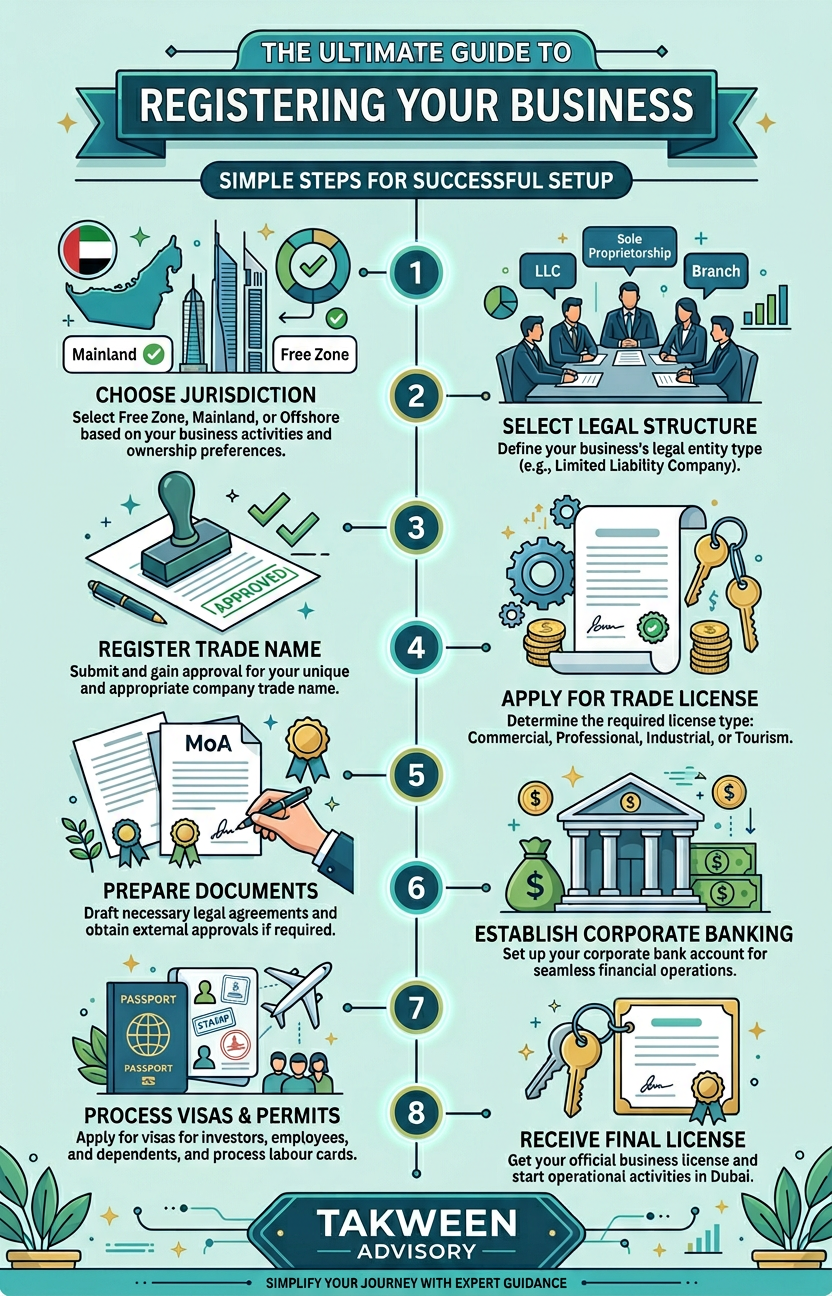
The emirate offers multiple opportunities across industries such as technology, logistics, tourism, e commerce, finance, and real estate. Entrepreneurs from around the world explore business setup in Dubai because the city provides access to international markets, modern business regulations, and strong government support for startups.
In this guide you will learn everything about company formation in Dubai including legal structures, licensing procedures, documents required, and expert tips for successfully setting up a company in dubai. Whether you are a startup founder, an investor, or an international entrepreneur, this guide will help you understand the entire process of setting up a business in Dubai.
Understanding Business Setup in Dubai
Why Dubai Is a Global Business Hub
Dubai is known for its business friendly environment and transparent regulatory framework. Entrepreneurs considering business setup in UAE benefit from strong infrastructure, advanced banking systems, and modern digital services.
Some key advantages of business setup in Dubai UAE include
Global connectivity through major international airports and ports
Strong government support for startups and investors
Modern legal and regulatory frameworks
Access to international markets
Tax efficient business environmentBecause of these advantages, Dubai business formation has become a popular choice for entrepreneurs who want to expand globally.
Types of Business Structures in Dubai
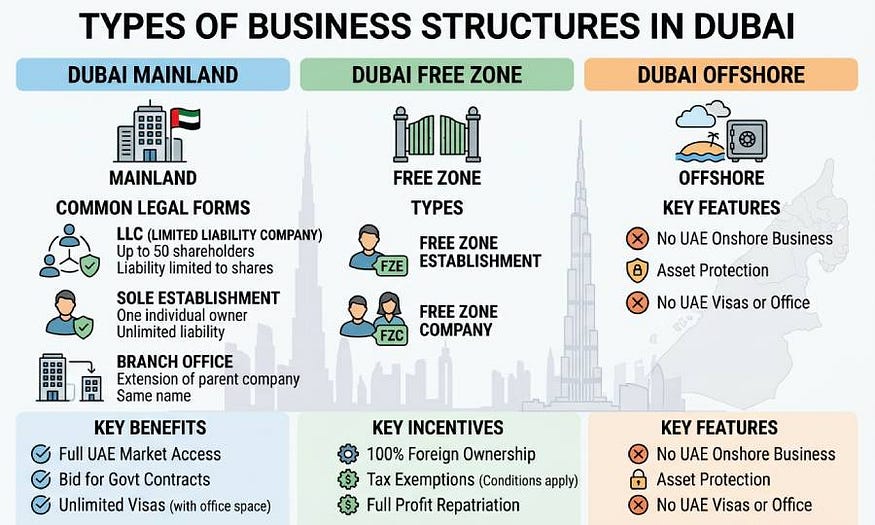
Before starting company setup Dubai, entrepreneurs must decide the most suitable business structure. Each structure has different regulations, ownership rules, and licensing requirements.
Mainland Company
A mainland company allows businesses to operate across the entire UAE market. Many entrepreneurs prefer this structure when they plan business expansion within the country.
Mainland companies are often chosen for business formation in Dubai because they allow flexibility in trading, government contracts, and office locations.
Free Zone Company
Free zones are special economic areas designed to attract international investors. Many startups choose free zones when planning new business setup in Dubai.
Benefits include
Full foreign ownership
Simplified licensing process
International trade advantagesFree zones have become an important part of company formation in Dubai for technology companies, startups, and digital businesses.
Offshore Company
Offshore companies are commonly used for international trade, asset protection, and holding companies. These companies are typically registered in Dubai but operate internationally.
For investors planning international operations, offshore structures can be a strategic option when they setup a company in Dubai.
Step by Step Process for Company Formation in Dubai
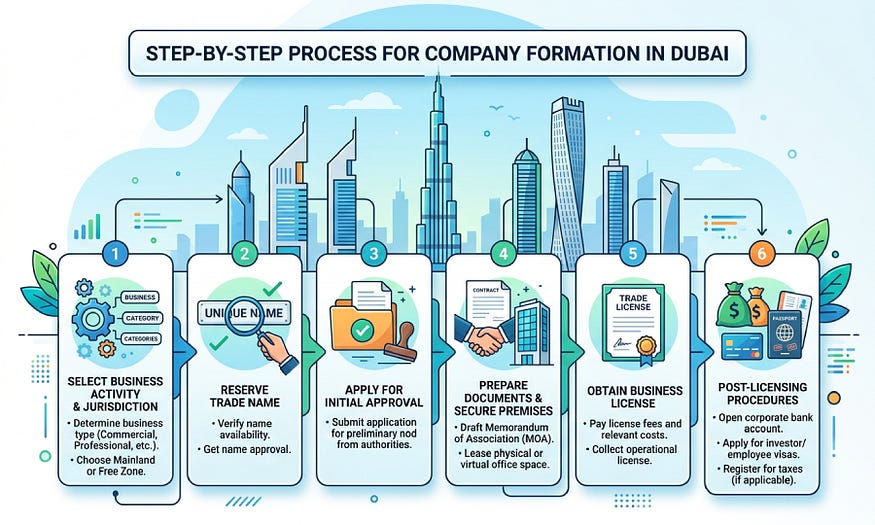
Understanding the correct process is essential for successful company incorporation in Dubai.
Step 1 Choose the Right Business Activity
The first step in business setup services is identifying the business activity. The chosen activity determines the type of license required and the regulatory authority responsible for approval.
Common categories include
Commercial activities
Professional services
Industrial activitiesSelecting the correct activity ensures smooth approval during business setup Dubai UAE.
Step 2 Select a Business Structure
After choosing the activity, entrepreneurs must select the legal structure for their company. This decision affects ownership rules, liability, and licensing.
Professional advisors and a reliable business setup company in dubai often help entrepreneurs choose the most suitable structure.
Step 3 Register the Trade Name
The trade name is the official identity of the company. During company setup Dubai, the name must follow government guidelines and should not duplicate existing registered names.
The trade name must represent the business activity and comply with local regulations.
Step 4 Apply for Initial Approval
Initial approval confirms that the government allows the proposed business activity and ownership structure. This is a mandatory step in business setup in Dubai.
After approval, entrepreneurs can proceed with licensing and documentation.
Step 5 Prepare Legal Documents
Several legal documents are required for company incorporation in Dubai. These may include
Memorandum of association
Shareholder agreements
Passport copies of owners
Office lease documentsProfessional consultants and company formation companies in Dubai often assist in preparing these documents correctly.
Step 6 Obtain Business License
The business license officially allows the company to operate. The license type depends on the business activity and jurisdiction.
Obtaining the correct license is one of the most important steps when setting up a company in dubai.
Step 7 Open a Corporate Bank Account
Once the license is issued, companies can open a corporate bank account. This step allows businesses to manage transactions, payments, and investments.
Most entrepreneurs completing business setup in UAE open their accounts with international or regional banks operating in Dubai.
Role of Business Setup Companies
Many entrepreneurs prefer working with a professional business setup company because the process involves legal procedures, documentation, and government approvals.
Benefits of Hiring Experts
Professional business setup services offer
Legal compliance guidance
Documentation support
License application assistance
Business advisory servicesWorking with a business setup company in dubai helps entrepreneurs avoid delays and ensures that the company registration process follows government regulations.
Many investors searching online for business setup near me often choose experienced consultants who understand the Dubai business environment.
Case Study: Startup Expansion into Dubai
A technology entrepreneur from Europe decided to expand his software company into the Middle East market. After evaluating several countries, he chose Dubai due to its global connectivity and investor friendly environment.
The entrepreneur worked with one of the company formation companies in Dubai to complete the company setup process. The consulting team assisted with licensing, documentation, and legal approvals.
Within a few months the company successfully completed business setup in Dubai UAE and launched operations serving clients across the Middle East and Asia.
This example demonstrates how structured guidance and proper planning can make Dubai business formation smooth and efficient.
Advantages and Challenges of Business Setup in Dubai
Advantages
Strategic global business location
Strong infrastructure and logistics network
Access to international markets
Business friendly government policies
Advanced digital economyThese advantages make setting up a business in Dubai attractive for entrepreneurs and global investors.
Challenges
Understanding regulatory procedures
Selecting the right jurisdiction
Preparing accurate legal documentation
Navigating licensing requirementsHowever, these challenges can be easily managed by working with a professional business setup company.
Frequently Asked Questions
How long does company formation in Dubai take
The timeline for company formation in Dubai depends on the business activity, approvals required, and documentation process. Many companies complete the process within a few weeks when documentation is prepared correctly.
Can foreign investors own a company in Dubai
Yes. Many business structures allow full foreign ownership, particularly in free zones and certain mainland activities.
Is Dubai suitable for startups
Yes. Dubai offers excellent infrastructure, government support programs, and international connectivity, making it an attractive destination for startups and investors.
Do I need consultants for company setup
Although it is possible to complete the process independently, many entrepreneurs choose professional business setup services to simplify legal procedures and documentation.
Conclusion
Dubai continues to attract global entrepreneurs who want to expand into international markets. With its modern infrastructure, investor friendly regulations, and strategic global location, the city provides an ideal environment for entrepreneurs planning business setup Dubai.
From selecting the right structure to completing company incorporation in Dubai, every step plays an important role in building a successful company. Entrepreneurs who understand the process of company formation in Dubai and work with experienced consultants can launch their businesses efficiently and confidently.
If you are planning business setup in Dubai UAE, now is the perfect time to explore opportunities and start building your global business presence. Share this guide with fellow entrepreneurs, leave your thoughts in the comments, and take the first step toward successful business setup Dubai.
Thank you for reading this blog and gaining valuable insights into group company setup Dubai and how it can help entrepreneurs and corporations expand their business presence across multiple sectors in the UAE. Setting up a group of companies in Dubai requires strategic planning, legal structuring, and compliance with local regulations to ensure smooth operations and long term growth. From choosing the right ownership structure to managing multiple licenses and approvals, every step must be carefully executed. With expert guidance, businesses can streamline the entire process and avoid unnecessary complications. Takween Advisory provides professional support tailored to complex business structures, helping you establish and manage group companies efficiently. Their experienced team ensures compliance, accuracy, and smooth execution at every stage. If you are ready to expand your business network, visit the Takween Advisory website today and book your consultation for expert assistance.
-
The Ultimate Checklist for Business Registration in 2026
Introduction
Starting a company in 2026 requires more than just an idea. Entrepreneurs need a clear roadmap, especially when planning a business setup in Dubai. With evolving regulations, digital processes, and competitive markets, having a structured checklist can save time, reduce errors, and ensure compliance.
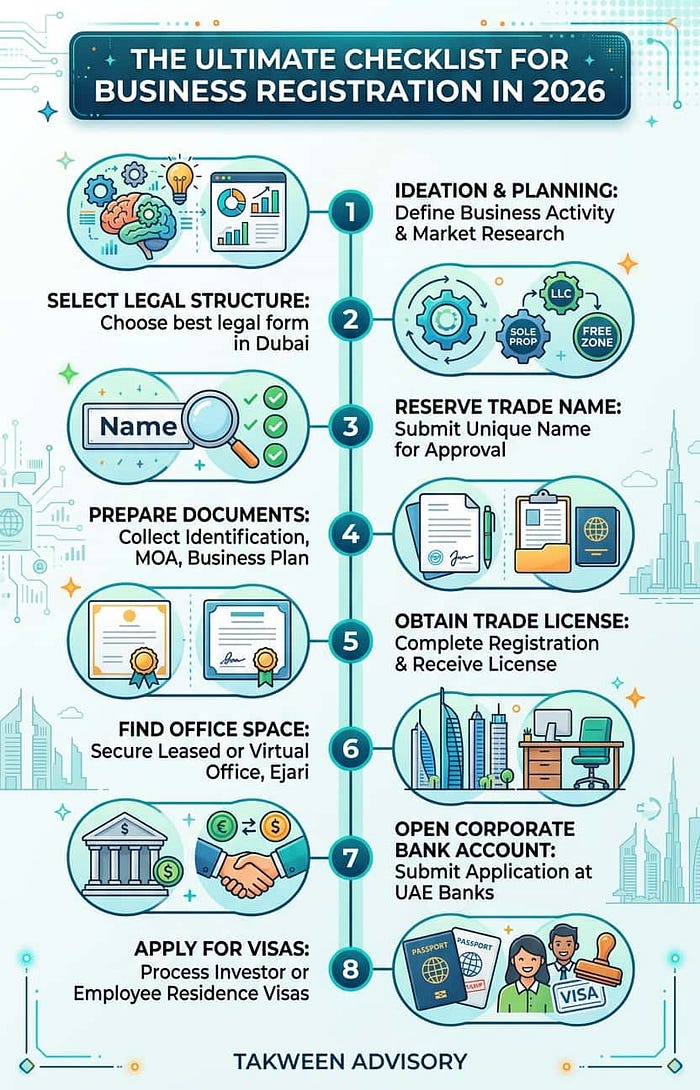
This guide will walk you through every essential step of business registration, from choosing the right structure to obtaining licenses and setting up operations. Whether you are a startup founder or an international investor, you will gain practical insights to streamline your business setup Dubai journey.
Why Dubai is a Leading Destination for Business Setup
Dubai continues to attract global entrepreneurs due to its strategic location, business friendly policies, and strong infrastructure. The city offers access to international markets, a stable economy, and simplified procedures for company formation.
Key advantages include full foreign ownership in many sectors, streamlined licensing systems, and access to a diverse customer base. These benefits make business setup Dubai a preferred choice for both small startups and large enterprises.
Complete Checklist for Business Registration in 2026

1. Define Your Business Activity
The first step in any business setup is selecting the right business activity. This determines the type of license you need and the regulatory approvals required.
Examples include
Trading
Consulting
E commerce
ManufacturingChoosing the correct activity ensures smooth approval and avoids delays later.
2. Choose the Right Business Structure
Selecting the appropriate legal structure is critical for compliance and scalability.
Common options in Dubai include
Mainland company
Free zone company
Offshore companyEach structure has different rules related to ownership, operations, and market access.
3. Select a Trade Name
Your business name must follow UAE naming guidelines. It should be unique, relevant to your activity, and free from restricted terms.
Tips
Avoid offensive or religious references
Ensure name availability before registration
Keep it simple and brand friendly4. Apply for Initial Approval
Initial approval confirms that the authorities have no objection to your business setup. This step allows you to proceed with documentation and licensing.
5. Prepare Legal Documents
Documentation plays a key role in business registration. Required documents typically include
Passport copies of shareholders
Business plan
Memorandum of Association
Application formsAccurate documentation ensures faster processing.
6. Choose Office Space
Depending on your business structure, you may need a physical office or a flexible workspace. Many free zones offer cost effective solutions for startups.
Having a valid office address is essential for license approval.
7. Obtain Business License
Once documents are approved, you can apply for your trade license. This is the official authorization to operate your business.
Types of licenses include
Commercial license
Professional license
Industrial license8. Open a Corporate Bank Account
After completing your business setup Dubai process, opening a bank account is necessary for financial transactions.
Banks may require
Trade license
Company documents
Shareholder details9. Apply for Visas
Business owners and employees need residency visas to operate legally in Dubai. Visa eligibility depends on your license and office setup.
10. Register for Compliance Requirements
Depending on your activity, you may need additional registrations such as VAT or industry specific approvals.
Staying compliant helps avoid penalties and ensures smooth operations.
Real Life Example
Consider a startup founder planning an e-commerce business. By choosing a free zone setup, they minimized operational requirements while gaining full ownership. With proper documentation and planning, the entire business setup was completed efficiently, allowing them to focus on growth and marketing.
Pros and Cons of Business Setup in Dubai

Pros
Access to global markets
Business friendly regulations
Flexible setup options
Strong infrastructureCons
Regulatory procedures require attention to detail
Initial documentation can be time consuming
Compliance requirements must be maintained regularlyFrequently Asked Questions
How long does business registration take
It depends on the business type and documentation, but proper planning can speed up the process significantly
Can foreigners start a business in Dubai
Yes, many sectors allow full foreign ownership, especially in free zones and selected mainland activities
Do I need a local sponsor
This depends on your chosen business structure and activity
Conclusion
A successful business setup starts with proper planning and a clear checklist. From selecting the right activity to completing documentation and licensing, each step plays a vital role in building a strong foundation. Entrepreneurs who understand the business setup Dubai process can avoid delays, reduce risks, and focus on growth opportunities. By following this checklist and staying compliant with regulations, you can establish a sustainable and profitable venture in Dubai. If you are planning your business setup journey, now is the time to take action, explore your options, and move forward with confidence.
Thank you for reading this blog. We hope it has given you a clear understanding of the Dubai trading license cost and how it impacts your business planning. Knowing the right structure and requirements helps you manage expenses while ensuring compliance with local regulations. Whether you are starting a new venture or expanding your operations, understanding the Dubai trading license cost allows you to make informed financial decisions and avoid unexpected challenges. If you are ready to move forward, visiting the Takween Advisory website is a smart step. Their experienced team provides expert guidance, helping you choose the right license and complete your setup smoothly so you can focus on growing your business in Dubai.
-
Top 5 Benefits of Government Relations Support in Dubai
Introduction
Setting up and running a business in Dubai involves more than just launching operations. Companies must regularly interact with government authorities for approvals, documentation, visas, and compliance. This is where Pro services Dubai plays a crucial role in simplifying these processes.
Government relations support, often referred to as Pro services, helps businesses handle administrative and legal requirements efficiently. Whether you are a startup or an established company, understanding the benefits of these services can save time, reduce stress, and ensure smooth operations. In this guide, you will explore the top advantages, practical insights, and how Pro services can support your business growth in Dubai.
What Are Pro Services in Dubai
Pro services refer to professional government liaison services that assist businesses in dealing with various administrative tasks. These include visa processing, license renewals, document attestation, labor approvals, and more.
Companies rely on Pro services to navigate Dubai’s regulatory environment efficiently and maintain compliance with local laws.
Why Government Relations Support Matters
Simplifies Complex Procedures
Dubai has a well structured regulatory system, but navigating it can be complex for new businesses. Pro services help simplify these procedures.
Ensures Compliance
Staying compliant with regulations is essential to avoid penalties. Government relations support ensures all processes are handled correctly.
Saves Time and Resources
Handling administrative tasks internally can be time consuming. Pro services allow businesses to focus on core operations.
Top 5 Benefits of Pro Services Dubai
1 Efficient Document Processing
Pro services handle documentation related to visas, licenses, and approvals. This ensures accuracy and reduces the risk of delays.
Key Areas Covered
Visa applications
Trade license renewals
Government approvals2 Time Saving and Convenience
Managing government procedures can take significant time. By outsourcing these tasks, businesses can focus on growth and strategy.
Pro services professionals are familiar with procedures and can complete tasks quickly and efficiently.
3 Compliance with Local Regulations
Dubai’s business environment requires strict adherence to legal requirements. Pro services ensure that all filings, renewals, and approvals are completed on time.
This reduces the risk of fines and operational disruptions.
4 Expert Guidance and Support
Pro service providers have in-depth knowledge of local laws and processes. They can guide businesses through complex requirements and provide practical solutions.
This is especially helpful for companies new to Dubai.
5 Streamlined Visa and Immigration Processes
Visa processing is a critical part of running a business in Dubai. Pro services manage employee visas, investor visas, and renewals efficiently.
This ensures that your workforce remains legally compliant and operational.
Key Areas Where Pro Services Are Used
Business Setup Support
From initial approvals to licensing, Pro services assist in the entire setup process.
License Renewals
Timely renewals are essential for business continuity, and Pro services ensure deadlines are met.
Document Attestation
They help in verifying and attesting documents required for official purposes.
Labor and Immigration Services
Handling employee visas, labor contracts, and renewals is a major part of Pro services.
Real Life Example
A startup in Dubai faced delays in visa processing due to incomplete documentation. After engaging Pro services Dubai, they streamlined their processes and completed all approvals efficiently.
This allowed the company to focus on business growth while ensuring compliance with regulations.
Pros and Cons of Pro Services
Pros
Saves time and effort
Ensures compliance with regulations
Reduces risk of errors
Provides expert supportCons
Requires external service provider
Dependence on third party for administrative tasksFrequently Asked Questions
What are Pro services in Dubai
Pro services are government liaison services that help businesses manage administrative and legal requirements.
Are Pro services necessary for all businesses
While not mandatory, they are highly beneficial for managing compliance and saving time.
Can startups benefit from Pro services
Yes, startups can use Pro services to simplify setup and regulatory processes.
How do Pro services improve efficiency
They handle complex procedures quickly and accurately, reducing delays.
Expert Tips for Choosing Pro Services
Select Experienced Providers
Choose a service provider with proven experience in Dubai’s regulatory environment.
Understand Your Requirements
Identify the services you need before selecting a provider.
Ensure Transparency
Work with providers who offer clear communication and updates.
Plan for Long Term Support
Choose a partner who can support your business as it grows.
Conclusion
Government relations support through Pro services Dubai is an essential component of running a successful business in Dubai. From handling documentation to ensuring compliance, these services provide efficiency, reliability, and peace of mind for business owners.
By leveraging Pro services, companies can focus on growth while leaving administrative complexities to experts. If you are planning to start or expand your business, now is the time to explore the benefits of Pro services and streamline your operations. Share your thoughts, ask questions, and connect with professionals to make your business journey in Dubai smoother and more efficient.
-
Understanding the Costs Involved in Dubai Trade Licence Renewal
Introduction
Renewing a business license is a critical responsibility for every company operating in Dubai. Failing to renew on time can lead to penalties, business disruption, and legal complications. If you are planning your Dubai trade licence renewal, it is essential to understand the different cost components involved and how they impact your business operations.
In this guide, you will learn everything about trade licence renewal Dubai, including the key cost factors, process, expert insights, and practical tips to manage your renewal smoothly.
What is Dubai Trade Licence Renewal
Dubai trade licence renewal is the process of extending your company’s legal permission to operate in Dubai. Every business must renew its licence annually to remain compliant with local regulations.
Whether you operate a small business or a large enterprise, renewing your trade licence renewal in Dubai on time ensures business continuity and avoids unnecessary risks.
Key Cost Components of Trade Licence Renewal Dubai
Government Fees
Government fees are the primary cost involved in Dubai trade licence renewal. These charges are mandatory and depend on your business activity and licence type.
Office Space or Ejari Renewal
One of the most important requirements for renew business licence Dubai UAE is having a valid office lease. The Ejari certificate must be renewed along with your licence.
The cost depends on:
-
Office location
-
Type of workspace
-
Lease agreement terms
External Approvals
Some businesses require approvals from additional authorities depending on their activity. These approvals may add to the overall trade licence renewal Dubai cost.
Administrative and Service Charges
If you work with business setup consultants in Dubai, they may charge service fees for handling documentation and approvals. These fees vary based on the complexity of your business.
Additional Permits and Renewals
Certain businesses may need to renew additional permits or certifications. This can include sector specific approvals that are required to continue operations legally.
Factors That Affect Renewal Costs
Business Activity
Different activities have different regulatory requirements. A trading company may have different renewal costs compared to a consultancy firm.
Business Location
Costs vary depending on whether your business operates in mainland or a free zone.
Company Size
The number of employees, office size, and operational scale can influence the overall renewal cost.
Compliance Status
If your company has any fines or violations, these must be cleared before completing trade licence renewal in Dubai.
Step by Step Renewal Process
Prepare Required Documents
Ensure all documents are updated and ready, including:
-
Valid tenancy contract
-
Previous trade licence
-
Passport copies
Submit Renewal Application
Apply through the relevant authority or online portal for Dubai trade licence renewal.
Pay Applicable Fees
Once your application is reviewed, you will need to complete the payment process.
Receive Renewed Licence
After approval, your renewed licence will be issued, allowing you to continue business operations.
Real Life Example
A small consulting firm in Dubai delayed their trade licence renewal due to incomplete documentation. As a result, they faced penalties and temporary suspension of operations.
After consulting experts and completing all requirements, they successfully renewed their licence and streamlined their internal processes to avoid future delays.
This example highlights the importance of timely action and proper planning.
Pros and Cons of Timely Renewal
Pros
-
Ensures legal compliance
-
Avoids penalties and fines
-
Maintains business reputation
-
Supports uninterrupted operations
Cons
-
Requires careful planning
-
Involves administrative processes
-
Costs can vary based on business needs
Frequently Asked Questions
How often should I renew my licence
Dubai trade licence renewal is typically required every year.
Can I renew my licence online
Yes, many authorities provide online services to renew business licence Dubai UAE quickly and efficiently.
What happens if I delay renewal
Delays can result in fines, restrictions, or even business suspension.
Do I need professional help
While it is possible to renew independently, many businesses prefer working with business setup consultants in Dubai for a smoother process.
Expert Tips to Manage Renewal Costs
-
Start the renewal process early
-
Keep all documents updated
-
Choose the right office space based on your needs
-
Work with experienced consultants for guidance
These steps can help reduce complications and manage your trade licence renewal Dubai efficiently.
Conclusion
Managing Dubai trade licence renewal effectively is essential for maintaining your company’s legal status and operational continuity. Understanding the various cost components such as government fees, office lease requirements, and administrative charges helps you plan better and avoid unexpected expenses.
When you renew business licence Dubai UAE on time, you not only ensure compliance but also strengthen your business credibility in a competitive market. A proactive approach to trade licence renewal in Dubai allows you to focus on growth without disruptions.
If you want a hassle free experience, consider seeking support from professionals who understand the local regulations and processes. Take action today, plan your renewal in advance, and keep your business running smoothly. If you found this guide useful, share it with others or connect with experts to simplify your renewal process.
-
-
Why Your Dubai Firm Needs a Corporate Tax Expert Now
Introduction
Dubai has long been known as a global business hub that attracts entrepreneurs, investors, and multinational companies. With its strategic location, world class infrastructure, and pro business policies, the city continues to support economic growth and innovation. However, with the introduction of corporate tax regulations in the UAE, businesses in Dubai now face a new financial and compliance environment.For many companies, navigating these regulations can be complex and time consuming. Understanding the rules, maintaining compliance, and planning tax strategies requires expertise and careful planning. This is why hiring a corporate tax expert has become essential for businesses operating in Dubai.
In this article, you will learn why your firm needs a corporate tax expert now, how professional guidance helps ensure compliance, and how businesses can benefit from working with experienced advisors in Dubai.
Understanding Corporate Tax in Dubai
Corporate tax is a direct tax applied to the net income or profits of businesses. The UAE introduced this system to align with global financial standards while maintaining a competitive business environment.
For companies operating in Dubai, corporate tax rules apply to various types of businesses including mainland companies, certain free zone entities, and multinational firms with operations in the UAE.
Understanding corporate tax dubai regulations is important for every company. Businesses must ensure that financial records, reporting processes, and tax filings meet the requirements set by authorities. Without professional guidance, companies may face compliance risks or missed opportunities for efficient tax planning.
Why Businesses Need Corporate Tax Experts
Complex Regulations Require Professional Knowledge
The introduction of corporate tax regulations means that businesses must adapt their financial management practices. Many companies previously operated in an environment with minimal tax obligations, so adjusting to new rules can be challenging.
A tax expert understands the legal framework, reporting requirements, and regulatory updates related to corporate tax. They help companies interpret the rules correctly and apply them to their business operations.
This expertise ensures that your firm stays compliant while avoiding costly mistakes.
Accurate Financial Reporting
Proper financial reporting is essential under company tax in Dubai regulations. Businesses must maintain transparent financial records and prepare accurate statements for tax purposes.
Corporate tax experts assist with reviewing financial records, ensuring that income, expenses, and deductions are properly documented. This helps companies avoid errors and ensures that tax filings are accurate and complete.
Strategic Tax Planning
Tax planning is not just about compliance. It is also about managing financial efficiency.
With professional guidance, businesses can structure their operations in a way that supports long term growth while complying with Dubai business tax regulations. Experts analyze financial activities and recommend strategies that help companies optimize their tax position.
How Corporate Tax Consultants Support Businesses
Compliance and Regulatory Guidance
Corporate tax consultants Dubai play an important role in helping businesses meet regulatory obligations. They stay updated with the latest government guidelines and ensure that companies follow the correct procedures for tax registration, filing, and reporting.
This support reduces the risk of penalties or legal complications.
Business Structure Evaluation
Many companies in Dubai operate under different structures including mainland businesses, free zone companies, and international branches. Each structure may have different tax implications.
A corporate tax consultant evaluates the company structure and advises whether adjustments are needed to align with corporate tax dubai requirements.
Audit Preparation and Documentation
Businesses may occasionally face financial audits or regulatory reviews. Preparing for these processes requires well organized documentation and accurate financial records.
Corporate tax experts help companies maintain compliance documentation and prepare for audits with confidence.
Real Life Example: A Growing Business in Dubai
Consider a technology company based in Dubai that experienced rapid growth over the past few years. When corporate tax regulations were introduced, the company faced challenges understanding how the new rules applied to its operations.
Without a tax expert, the company struggled with financial reporting, tax registration, and compliance planning. After working with corporate tax consultants Dubai, the business received professional guidance on financial structuring and tax reporting.
As a result, the company improved its financial transparency, avoided compliance issues, and gained a clear tax strategy that supported its continued growth.
This example highlights the importance of expert guidance in a changing regulatory environment.
Benefits of Hiring a Corporate Tax Expert
Improved Compliance
Professional tax experts ensure that businesses follow all corporate tax regulations. This reduces the risk of penalties or regulatory challenges.
Time and Resource Efficiency
Managing tax requirements internally can take significant time and resources. By working with experts, companies can focus on their core operations while specialists handle compliance and planning.
Better Financial Strategy
Tax professionals provide insights that help businesses plan for long term financial success. Their expertise allows companies to make informed decisions regarding investments, expansions, and financial management.
Reduced Risk
Tax regulations can change over time. Corporate tax consultants monitor updates and ensure that businesses adapt quickly to any new requirements.
Possible Challenges Without a Tax Expert
While some businesses attempt to manage tax compliance internally, this approach can create risks.
Lack of professional guidance may lead to reporting errors, missed deadlines, or misunderstandings of tax regulations. These issues can affect financial stability and potentially damage a company’s reputation.
Hiring a corporate tax expert reduces these risks and ensures that businesses remain aligned with regulatory standards.
Frequently Asked Questions
What is corporate tax in Dubai
Corporate tax is a tax applied to the profits of businesses operating in the UAE. It aims to align the country with international tax standards while supporting economic growth.
Do all companies need to comply with company tax in Dubai
Most businesses operating in Dubai must understand and comply with corporate tax regulations depending on their structure and activities.
Why should businesses hire corporate tax consultants Dubai
Professional consultants provide expert guidance on compliance, reporting, and tax planning. Their support helps businesses navigate complex regulations effectively.
How does Dubai business tax impact companies
Dubai business tax regulations require companies to maintain proper financial records, submit accurate tax filings, and follow compliance standards set by authorities.
Conclusion
The introduction of corporate tax has created a new financial landscape for businesses in Dubai. Companies must adapt to updated regulations, maintain transparent financial records, and ensure compliance with legal requirements.
Working with a corporate tax expert is one of the most effective ways to manage these responsibilities. Professional advisors help businesses understand corporate tax rules, develop strategic tax plans, and maintain compliance with company tax in Dubai regulations.
As the business environment continues to evolve, expert guidance will remain essential for companies that want to grow and operate confidently in Dubai. If your business has not yet explored professional tax support, now is the time to consider working with experienced corporate tax consultants Dubai.
If you found this article helpful, share it with other business owners, leave a comment with your questions, or connect with a tax professional to learn how your company can stay compliant and financially strong in Dubai.
-
Cheapest Trade License in Dubai for New Businesses
Introduction
Starting a business in Dubai is an exciting opportunity. The city offers global connectivity, tax advantages, and a strong regulatory framework that attracts entrepreneurs from around the world. However, one of the first questions new founders ask is how to obtain the cheapest trade license in Dubai without compromising compliance or long term growth.
In this guide, you will learn how trade licensing works, what affects costs, how a ded license Dubai compares with free zone options, and how to choose the right structure for your business goals. Whether you are a freelancer, startup founder, or small business owner, this article will help you make informed decisions.
Understanding Trade Licenses in Dubai
A trade license is a legal document that allows you to conduct business activities in Dubai. It is issued by the relevant authority depending on your chosen jurisdiction.
For mainland businesses, licenses are issued by the Dubai Department of Economy and Tourism, commonly referred to as DED. This is why many entrepreneurs search for ded license Dubai when planning their setup.
Free zone licenses, on the other hand, are issued by individual free zone authorities.
Types of Trade Licenses Available
Understanding the license categories is essential when looking for the cheapest trade license in Dubai.
1. Commercial License
Issued for trading activities such as buying and selling goods, import and export, and general trading.
2. Professional License
Designed for service based businesses like consulting, marketing, IT services, and freelancers.
3. Industrial License
Required for manufacturing or industrial activities.
The type of license you select directly impacts overall setup requirements and approvals.
What Determines the Cheapest Trade License in Dubai
There is no fixed price because the final cost depends on multiple variables. Instead of focusing only on cost, it is important to understand what influences it.
1. Business Activity
Each activity has its own regulatory requirements. Some activities require additional external approvals, while others are straightforward.
2. Jurisdiction Choice
You can choose between:
-
Mainland company formation
-
Free zone company setup
A ded license Dubai allows businesses to operate across the UAE market without restrictions, while free zones may limit direct mainland trading unless additional arrangements are made.
3. Office Requirement
Mainland companies typically require a registered office space. Free zones may offer flexi desk or shared workspace solutions. The type of office selected directly affects overall expenses.
4. Visa Allocation
The number of visas required for shareholders and employees plays a significant role in total setup cost.
5. Government Fees and Approvals
These may include:
-
Trade name reservation
-
Initial approval
-
License issuance
-
Immigration establishment card
-
Chamber of Commerce registration
All these components influence the final figure.
Mainland vs Free Zone for Cost Conscious Entrepreneurs
When searching for the cheapest trade license in Dubai, many entrepreneurs compare mainland and free zone options.
Mainland License Benefits
A ded license Dubai allows you to:
-
Trade directly within the UAE market
-
Work with government contracts
-
Open physical retail stores anywhere in Dubai
However, mainland companies must comply with office space requirements and certain regulatory standards.
Free Zone License Benefits
Free zones offer:
-
100 percent foreign ownership
-
Simplified registration process
-
Flexible workspace options
They are ideal for service based businesses or international trading companies.
Choosing the cheapest option depends on your business model, not just the license fee.
Real Life Example
Consider a freelance graphic designer who wants to serve clients globally. She does not require a physical shop or retail presence. Instead of opting for a large office in mainland Dubai, she selected a flexible workspace solution in a free zone.
Her decision helped reduce initial overhead while maintaining full legal compliance. As her business grew, she upgraded her license structure and workspace.
On the other hand, a retail entrepreneur selling consumer goods across Dubai opted for a ded license Dubai to ensure direct access to the local market. While his setup involved more regulatory steps, it allowed him to expand freely across the UAE.
Both examples show that the cheapest trade license in Dubai depends on business goals and operational needs.
Expert Tips to Reduce Trade License Costs
If you want to optimize your setup without compromising compliance, consider the following:
Choose the Right Business Activity
Avoid selecting unnecessary activities that increase regulatory complexity.
Start with Essential Visas Only
Apply for the number of visas you genuinely need in the beginning.
Select Practical Office Space
Choose a workspace aligned with your business size and growth stage.
Work with Licensed Consultants
Professional advisors understand regulatory procedures and help prevent costly mistakes or delays.
Pros and Cons of Choosing the Cheapest Option
Pros
-
Lower initial investment
-
Reduced operational pressure
-
Faster return on investment
-
Suitable for startups and small businesses
Cons
-
Limited activity flexibility in some jurisdictions
-
Potential upgrade costs later
-
Restrictions depending on license type
Choosing purely based on cost without understanding long term requirements can create operational challenges.
Frequently Asked Questions
Is mainland or free zone cheaper?
It depends on your business activity, office needs, and visa requirements. Service based businesses often find free zones more flexible, while trading businesses benefit from mainland access.
Can I upgrade my license later?
Yes. Many entrepreneurs start with a basic structure and upgrade as their business grows.
Do I need a physical office for a ded license Dubai?
Yes, mainland companies require a registered office address approved by authorities.
Is a trade license mandatory?
Yes. Operating without a valid license in Dubai is illegal and can result in penalties.
Why Compliance Matters
Dubai has a strong regulatory framework that promotes transparency and investor confidence. Whether you choose a ded license Dubai or a free zone license, compliance ensures smooth banking processes, visa approvals, and long term business stability.
Entrepreneurs should focus on sustainable growth rather than short term savings alone.
Conclusion
Finding the cheapest trade license in Dubai is not simply about selecting the lowest fee option. It is about aligning your license type, jurisdiction, workspace, and visa requirements with your business goals.
Mainland licenses offer full UAE market access, while free zones provide flexibility and ownership advantages. The right choice depends on your industry, client base, and expansion plans.
If you are planning business setup in Dubai, consult a qualified advisor to evaluate your options. Share your questions in the comments, connect with experts, and take the first step toward launching your business confidently in one of the world’s most dynamic markets.
-

You’re offline. This is a read only version of the page.
